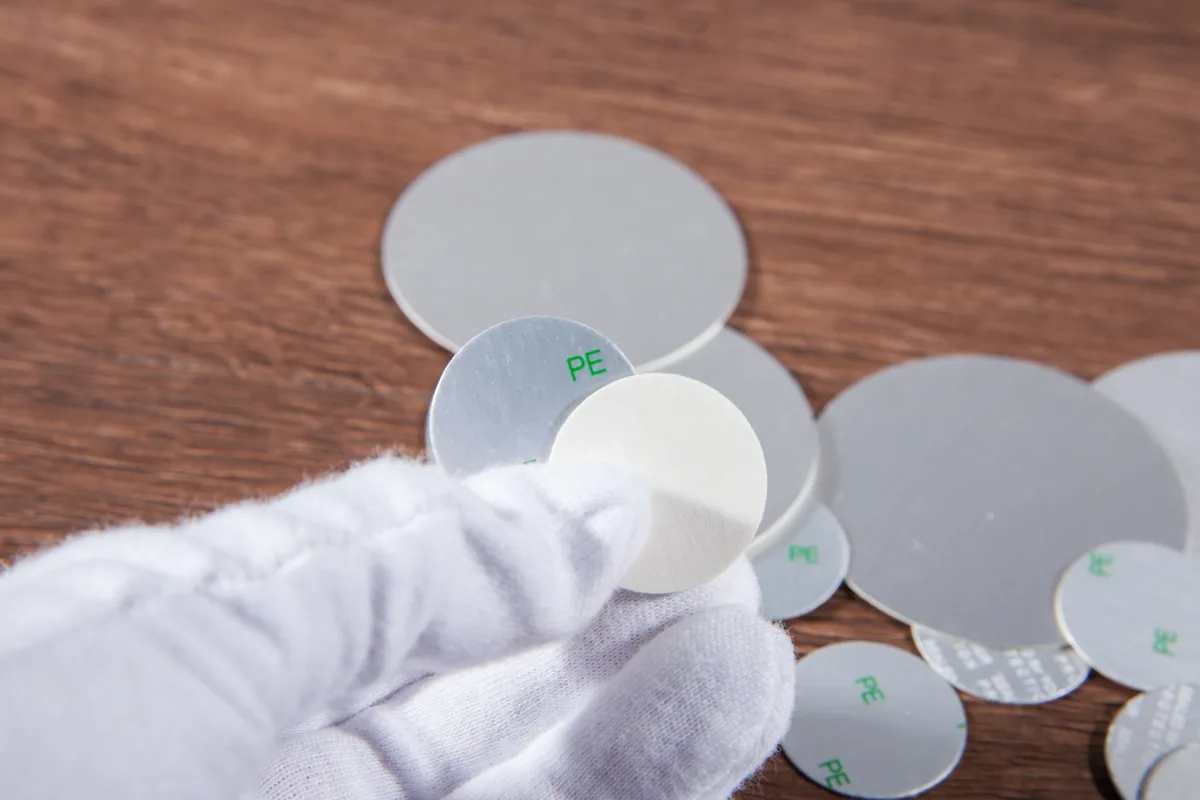
What to send.
- The bottle or a neck drawing, with the finish and the cap.
- The contents, including alcohol, oil, acid or aroma.
- The current liner, if there is one, and what it is not doing.
- The sealing method and the line speed.
- The target quantity and whether you need discs or roll stock.
A photo with a ruler is useful for a first conversation. It is not a substitute for the drawing or the physical sample when the disc is cut.
The sample path.
- Request. Send the application through the contact form. You do not need a final specification.
- Review. We read the bottle, contents and line, and reply with the questions that are still open.
- Sample kit. If a sample is the next step, we put together the candidate families — usually within 2–7 working days — and confirm the courier details with you.
- Trial on your line. You run the discs on your own bottles and equipment, at your conditions, not on a lab substitute.
- Record. You record the settings and the result: seal, torque, leak, appearance, and what changed.
- Confirm. Only a trial that you accept becomes the written specification the order is made against.
What a sample does and does not prove.
A sample proves that the candidate can be made, handled and trialled. It does not prove a multi-year shelf life, a universal fit, or that the same result will hold on a different line. The trial on your line, with your product, is the evidence that matters — and it is why we ask for the trial record before a bulk order.
A note on lead times. Sample kits usually ship in 2–7 working days. Bulk production usually runs 2–15 working days after the specification and order are confirmed. These are usual windows, not a promise for every structure; the quotation states the lead time for the order.