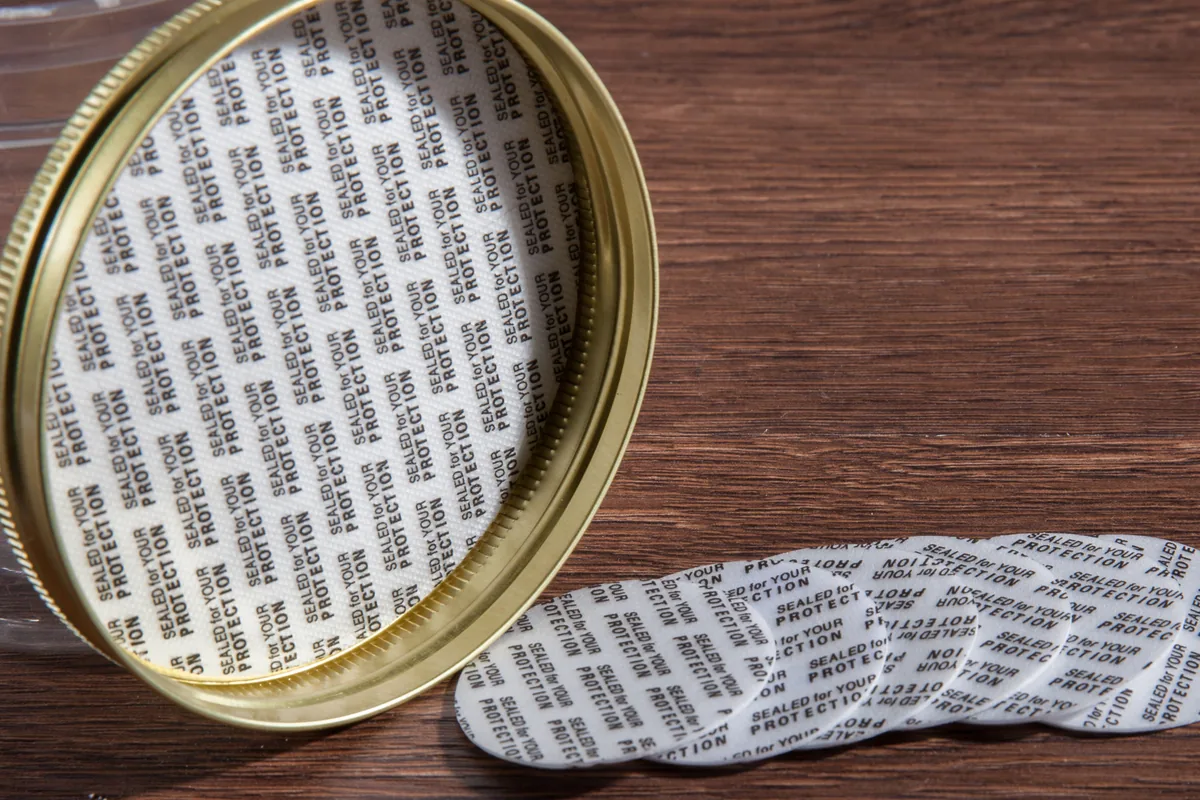
What can be customized.
Customization is defined against the bottle, the contents and the line. The list below is what we can change; which of them are open for a given order is confirmed in the specification.
Dimensions and profile
Disc diameter, profile and thickness cut to the cap and neck finish — from a drawing, a sample or a measured cap.
Material and structure
PE foam, foil, foil-and-foam, paper, barrier and vented structures. The facing is selected for the contents.
Print and emboss
Customer logo, text or pattern on the back; embossing for a tactile mark. Artwork and colour are approved on a proof.
Opening features
Half tab, full tab, easy-peel or a more permanent seal. The tab is a handling feature, not a barrier.
Format
Die-cut discs or roll stock, depending on whether your line drops a disc or seals from a roll.
Packing
Counted bags and export cartons; private-label packing and labelling can be quoted for the order.
What we need before quoting.
- The bottle and neck finish. A drawing, a 3D file or a physical sample. A photo with a ruler is a start, not a substitute.
- The cap. Material, internal height and whether it is a screw cap, a lug cap or a press-on closure.
- The contents. Product type, alcohol or oil content, acidity, and the storage conditions the pack has to survive.
- The sealing method. Induction, pressure-sensitive, or a physical foam seal — and the equipment you already have.
- The target quantity and format. Samples first, then the annual or per-order volume, as discs or rolls.
- Artwork, if printed. A vector file and the colour reference; we will confirm the printable area before proofing.
Where customization stops.
A drawing can tell us the shape. It cannot tell us whether the contents will migrate through the facing, whether the cap torque will hold the seal, or whether the line will run the disc at speed. Those questions are answered by a sample and a trial on your line — not by a longer specification.
If a requested change would move the product outside the structure we can support, we will say so before quoting. We would rather lose the line than ship a liner that fails in the field.